On July 1st, the full Senate of the Massachusetts Legislature approved S.3145 (our “dark-sky bill”) by a unanimous 39-0 vote. This marks the first time that this proposed legislation had reached the Senate floor as a standalone bill. More remarkable was the individual roll-call vote — a marked departure from the chamber’s more typical rapid-fire yes-no approach.
The bill requires that all state- and municipally-funded outdoor-lighting installations be fully shielded, have a color temperature not exceeding 3000K, and meet basic requirements to avoid overlighting. It also requires the Dept. of Public Utilities to establish new utility rates that will benefit towns that install low-wattage LED streetlights. And it tasks Mass DOT with researching, publishing, and (hopefully) adopting “best practices” for its outdoor-lighting installations.
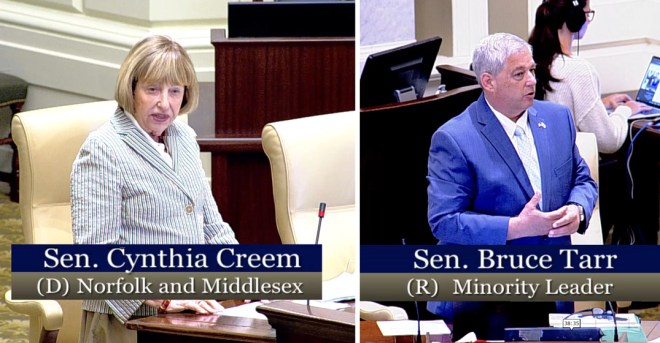
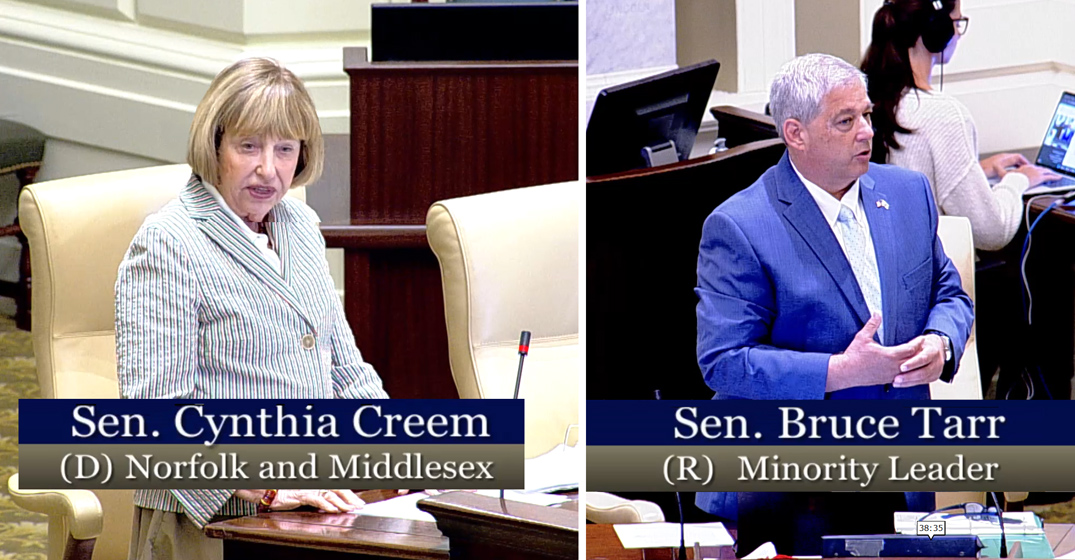
During July 1st’s session, Sen. Cynthia Creem (the bill’s longtime champion in the Senate) told her colleagues about the legislation’s many advantages in the broader effort to curb light pollution. She was followed at the podium by Sen. Bruce Tarr, the Senate’s minority leader and another long-time supporter. Then Sen. John Keenan offered a simple amendment to add the inclusion of wildlife safety to the bill’s justification, which was approved.
Click here to view Sen. Creem and Sen. Tarr’s remarks and the announcement of the bill’s unanimous passage. To view the entire proceeding, including the roll-call vote, go to the Legislature’s video recording of the session and start at the 31:10 mark. And here is the press release issued by the Senate after the S.3145’s passage (including quotes from the key DarkSkyMass volunteers and other supporters involved in the legislative effort).
The Senate vote caps a whirlwind two weeks for the twin House and Senate dark-sky submissions. The first success came late on June 17th, when the House voted to include the dark-sky text as an amendment to its MassReady act — a environmental bond bill that provides $3.5 billion to fund a host of environmental programs. That success was orchestrated by Reps. Sean Garballey and Simon Cataldo, our bill’s principal House sponsors, and dark-sky amendment was approved by a resounding 151-0 vote. (House members typically propose hundreds of such amendments for these big “must pass” bills, but only a rare few are accepted.)
Despite the dark-sky bill’s approvals in both of the Legislature’s chambers, what happens next is unclear. The House and Senate have approved different versions of the MassReady Act, and those will be reconciled later this year by a House-Senate conference committee. But our bill is not in the Senate version of the act that was approved on April 15th — instead, it got taken up as a standalone bill on July 1st. Procedurally, the Senate will now forward S.3145 to the House for consideration. H.3494, the House version of our bill, remains viable and could still be approved with a separate vote on the House floor before July 31st, when the Legislature’s two-year term formally ends.
More likely, the House-Senate conference committee (which will be meeting after July 31st and throughout the remainder of 2026) will add our bill as an amendment to the Senate’s version of the MassReady Act.
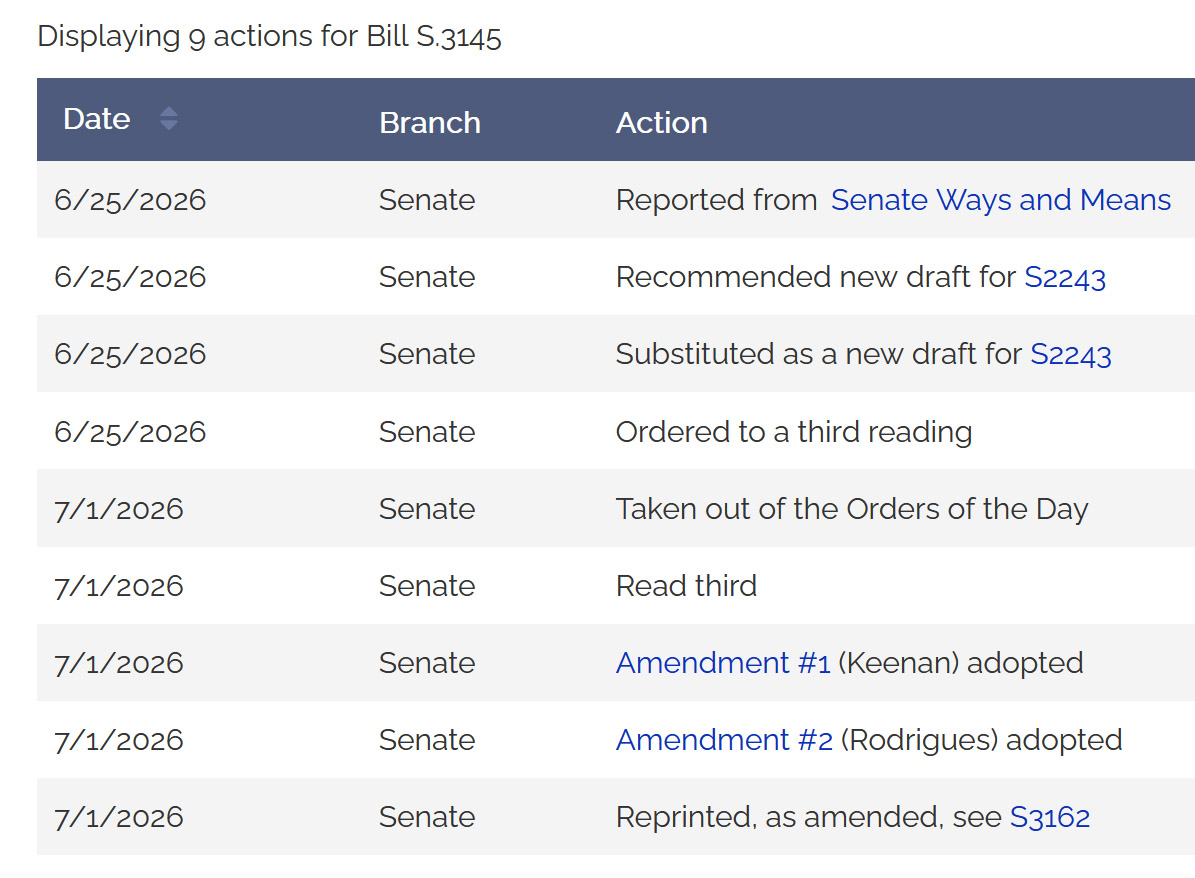
NOTE: Because the bill’s text was amended during the Senate debate, it’s been given a new number — S.3162 — and that’s what it will carry forward during the consensus process:
Whatever the path forward, it appears that the entire Legislature — and Senate leadership in particular — seems to have suddenly embraced our dark-sky bills. It’s a remarkable turn of events. DarkSkyMass records show that statewide dark-sky legislation was first proposed in 1992. So these most recent successes represent a significant (but still incomplete) achievement that’s been 34 years in the making.


One thought on “Senate Passes Dark-Sky Bill!”