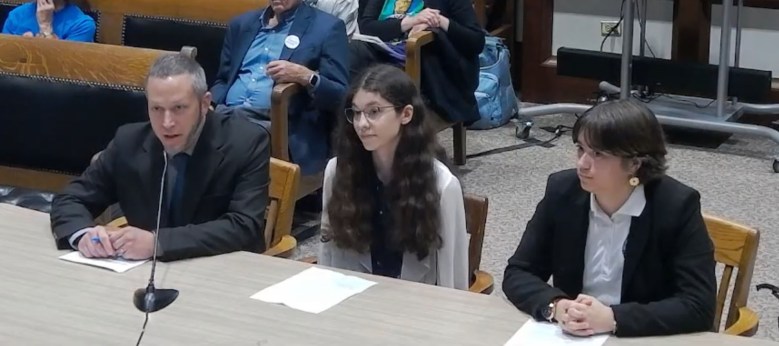
Legislation usually progresses slowly on Beacon Hill, and our proposed dark-sky bill is no exception. On September 25th, the Legislature’s Joint Committee on Telecommunications, Utilities, and Energy held a public hearing for several bills, including ours. Testifying in person were DarkSky Massachusetts’ Timothy Brothers, along with MIT students Ella Sheffield and Erin Cusson. Chapter president James Lowenthal (joining remotely) and others a;sp spoke in support of the bill.
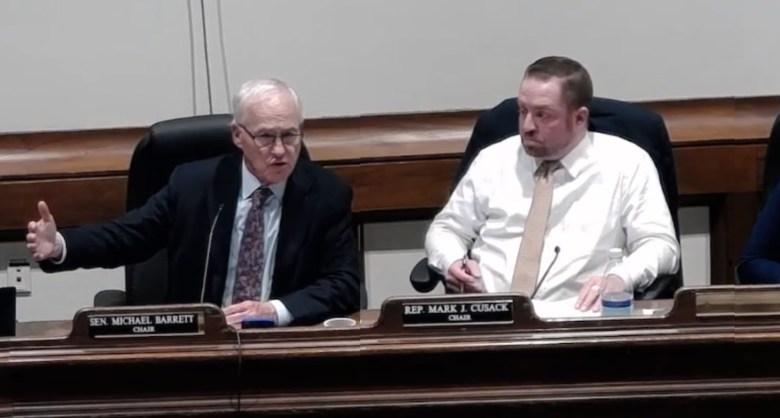
It’s the first step on a convoluted road to passage. The hearing was led by TUE’s longtime Senate chair Mike Barrett along with Rep. Mark Cusack, who was recently appointed to be the House committee co-chair. You can view the hearing here (the dark-sky testimony begins one hour after the beginning).
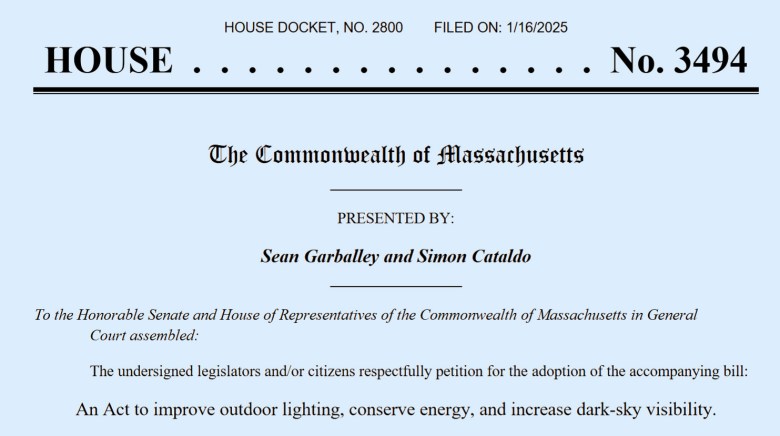
Now DarkSky Massachusetts is proud to announce a significant milestone in our campaign to protect the Commonwealth’s night sky. On November 26th, we learned to share that S.2243 (the Senate version of An Act to improve outdoor lighting, conserve energy, and increase dark-sky visibility) has been passed favorably out of the Joint Committee. (We await word on similar action by TUE’s House members.)
Why This Matters Now
This is a critical victory for our movement, but our work is far from finished. Massachusetts is the only New England state that has not yet passed outdoor-lighting legislation. While our neighboring states have enacted measures to limit light pollution, reduce energy waste, and protect wildlife, the Commonwealth has lagged behind. It is time for us to close that gap and lead by example.
This bill, along with its identical House version H.3494, represents a practical, common-sense approach to modernizing our public infrastructure. It does not demand that we live in the dark; rather, it mandates that our communities be illuminated responsibly. The bill would require the Department of Energy Resources to develop regulations ensuring that state or municipal funds are used only for compliant permanent outdoor fixtures. Specifically, new publicly funded lighting must meet the following standards:
- Fully Shielded: Streetlights and parking lot lights must be fully shielded, directing light downward where it is needed, rather than sideways into homes or upward into the sky.
- Warmer Colors: A light fixture’s Correlated Color Temperature (CCT) must be no greater than 3000 Kelvin. This ensures we avoid the harsh, blue-rich white light that disrupts human circadian rhythms and nocturnal ecosystems.
- Appropriate Intensity: Lighting must provide illuminance levels no greater than necessary for the intended purpose, ensuring safety without excess waste.
- Protection from Glare: Façade and aesthetic lighting must be shielded to minimize glare and light trespass.
Note: The bill includes crucial exemptions where public safety needs are demonstrated, or for specific uses such as athletic fields and navigational safety.
Passing S.2243 and H.3494 creates a triple-win scenario for our state, First, this legislation requires that new lighting fixtures be fully shielded, that is, sending all of their output below horizontal and thus curbing the sky glow that obscures our view of the cosmos. It would go a long way to “reclaiming the night” for astronomers, nature lovers, and future generations,
Second, it would improve public health and safety by reducing glare (thus improving visibility for drivers and pedestrians), while limiting harmful blue light protects human health.
Third, passing this bill would provide a huge economic win for municipalities. Crucially, it mandates that the Department of Public Utilities develop a specific rate for unmetered roadway or parking-lot fixtures that use less than 25 watts of electricity.
This provision is a game-changer for towns and cities, allowing them to finally incentivize the installation of ultra-efficient LED streetlights combined with smart controllers and dimmers. Currently, outdated utility rate structures fail to reward the full energy savings from low wattage LED lighting. This new rate would ensure that when towns invest in technology to reduce consumption, they see a return on investment directly in their budget.
Call to Action
This bill has cleared a major hurdle in the Senate, but we need your voice to turn this bill into law. Please take five minutes today to contact your state legislators. Let them know you support S.2243 and H.3494. Tell them that the Commonwealth is ready to join the rest of the Northeast in preserving our night skies. Please make sure to contact both your State Representative and State Senator. You can locate them easily by entering your address here. To help your effort, download this two-page fact sheet about the bill.
Together, we can bring back the stars!
 darkskymass.org